Background
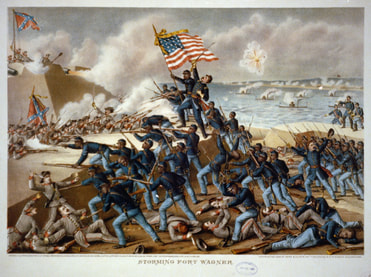
54th Massachusetts at Fort Wagner (Courtesy of Wikipedia)
|
Since the beginning of the war, black enlistment had proved a controversial topic. While fugitive slaves and free blacks were allowed to serve in the Union Army as early as late 1862, they were restricted from combat duties until the issuing of General Order No. 143 on May 22, 1863.[1] Due to a mixture of racial prejudice and political concerns over well-documented Confederate reprisals against USCT in battles like Fort Pillow and Fort Wagner, however, Union commanders still often refrained from
|
General Ferrero's 4th Division
|
Initially, Burnside selected General Edward Ferrero’s 4th Division to lead the assault. Although picked because they were fresh, Burnside’s decision would prove controversial, as Ferrero’s command was composed entirely of United States Colored Troops. Due to Union policy, the 4th Division had seen almost no action during the Overland Campaign and the men were anxious for an opportunity to prove themselves. Lieutenant Colonel Henry S. Hall’s 43rd USCT regiment, selected both to lead the division’s attack and push right down the Confederate earthworks upon reaching the crater, described how his mission was “fully
|
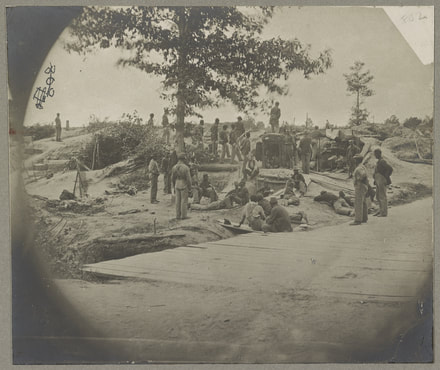
USCT in the trenches at Petersburg (Courtesy of Encyclopedia of Greater Philadelphia)
|
explained,” and how he and his regiment “practiced these movements till they could have been executed as perfectly in the dark as in the light…”[3]
Last Minute Changes
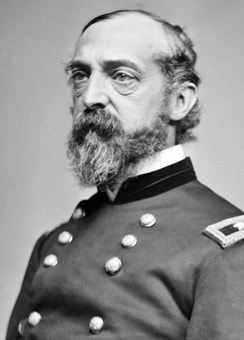
General George Meade (Courtesy of Wikipedia)
|
Unfortunately, all this preparation would come to nothing as General Meade, concerned that it would look like the USCT had been used as cannon fodder for white troops if the attack went wrong, ordered Burnside to select a different division on July 29, less than 24 hours before the assault was to begin.[4] Meade’s change wreaked havoc on Burnside’s plan of attack. The white troops assigned to replace Ferrero’s division had no time to properly prepare; LTC Hall’s 43rd USCT weren’t even made aware of the change until a few hours before the attack began.[5]
|
Despite its terrible timing, there was some justification behind Meade’s decision. Union commanders had been guilty of giving USCT such orders in the past (most notably at Port Hudson in May 1863), but perhaps an even larger concern was the Confederate treatment of black POWs.[6]
|
At battles like Fort Wagner, Milliken’s Bend and Olustee ,Confederate troops had brutally murdered wounded and captured black troops.[7] While not officially sanctioned by their government, Confederate troops faced no repercussions for these acts and were even encouraged to do so in some cases. One of these was the massacre at Fort Pillow, where surrendering and wounded black soldiers were
|
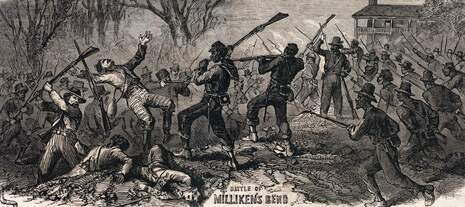
Battle of Milliken's Bend (Courtesy of American Battlefield Trust)
|
tortured and executed in horrendous ways, ranging from burnings to being buried alive.[8] The USCT, however, were well aware of these events; so much so that “Remember Fort Pillow!” had become a frequent battle cry for black regiments.[9] Whether Meade sought to protect the black soldiers from reprisals or politically save his own skin, his last-minute order served only to bring about the very massacre he had hoped to avoid.
Citations
Cover Image: USCT at L'Overture Hospital, Virginia. Several of the men depicted were wounded at the Crater [link]
[1] Jim Percoco, “The United States Colored Troops,” American Battlefield Trust. [link]
[2] Varon, 323-326, 278-279.
[3] Hall, 16. [link]
[4] Greene, 421-422; Levin, 11-12; Message from Major General A.A. Humphreys to Major General Burnside, July 26, 1864, OR, ser. 1, vol. 40, part 1, 137. [link]
[5] Hall, 16-17.
[6] John David Smith, Lincoln and the U.S. Colored Troops, (Illinois: South Illinois University, 2013), 77.
[7] Smith, 78-79.
[8] Smith, 79-80.
[9] Smith, 83.
[1] Jim Percoco, “The United States Colored Troops,” American Battlefield Trust. [link]
[2] Varon, 323-326, 278-279.
[3] Hall, 16. [link]
[4] Greene, 421-422; Levin, 11-12; Message from Major General A.A. Humphreys to Major General Burnside, July 26, 1864, OR, ser. 1, vol. 40, part 1, 137. [link]
[5] Hall, 16-17.
[6] John David Smith, Lincoln and the U.S. Colored Troops, (Illinois: South Illinois University, 2013), 77.
[7] Smith, 78-79.
[8] Smith, 79-80.
[9] Smith, 83.
