Casualties
|
The Battle of the Crater was a complete disaster for Union forces. In a battle that lasted under 10 hours, the Union Army of the Potomac suffered 3826 casualties of 8500 engaged while the Confederates suffered 1491 of 6100 engaged. The battle’s intense close quarter combat, presence of vast earthworks, use of mining and restriction to a relatively small area created a scene unlike any battle before it. One Confederate officer described bodies “lying in piles three and four deep,” in the crater and nearby entrenchments.[1]
|
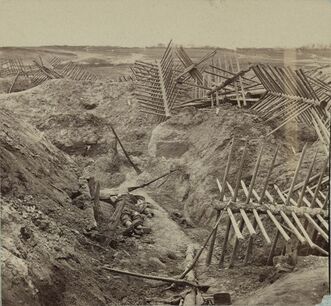
Confederate Dead at Petersburg (Courtesy of Pinterest)
|
Confederate Atrocities
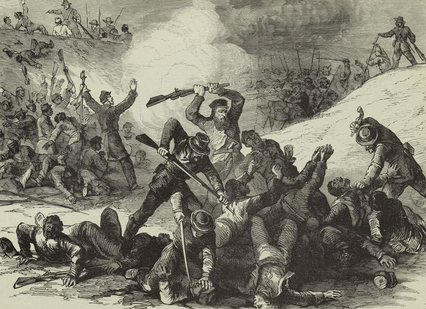
Confederates Massacre Black Prisoners at Fort Pillow (Courtesy of Wikipedia)
|
The presence of Ferrero’s two brigades of USCTs added a unique layer of racial violence to the already brutal scene. For Confederate soldiers, the sight of the USCTs and their cries of “Remember Fort Pillow!” and “No quarter!” brought forth a collective rage that spelled harsh consequences for black soldiers even after the battle had ended.[2] Historian Kevin Levin notes that, as the Confederates were defending a town with a large civilian population, the southern memory of events like Nat Turner’s 1831 rebellion would have spurred them to do
|
everything in their power to make sure, in their minds, that a massacre of innocent whites by rampaging blacks would not happen again.[3] Numerous Confederate accounts from the battle vividly describe the vengeful killing of black prisoners: “The Bayonet was plunged through their hearts & the muzzle of our guns was put on their temple & their brains blown out others were knocked in the head with the butts of our guns.”[4] The cries for mercy from captured USCTs fell on deaf ears, as Private George Bernard
|
recounts how a Confederate soldier fired at a black sergeant who was begging for mercy while his companion beat the man with a ramrod. His first shot only grazed the man, so he calmly reloaded, “…and, placing its muzzle close against the stomach of the poor negro, fired.”[5] “Within these ten minutes,” recalls Bernard, “the whole floor of the trench was strewn with the dead bodies of negroes, in some places in such numbers that it was difficult to make one’s way along the
|
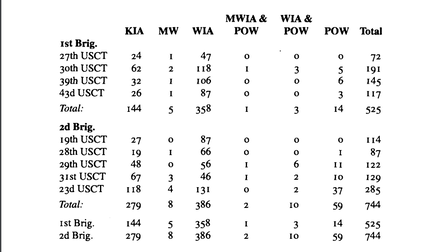
Casualty figures from Ferrero's 4th Division adjusted to include Confederate killings (Courtesy of Bryce A. Suderow)
|
trench without stepping on them.”[6] As a result of this brutality, Ferrero’s USCTs accounted for 41 percent of Union casualties, despite making up only 21 percent of the troops engaged. Historian Wilson Greene notes that the USCTs sustained a killed to wounded ratio of 1:1.7; the ratio for white units was 1:4.8.[7] Historian Bryce A. Suderow has calculated that, of the 368 USCTs missing after the battle, all but 85 were murdered, making it the worst massacre of USCTs by Confederate troops of the entire war.[8] Those who survived the Confederate reprisals were paraded through the streets of Petersburg (alongside their white counterparts) to the racial taunts of the city’s civilians.[9]
Repercussions
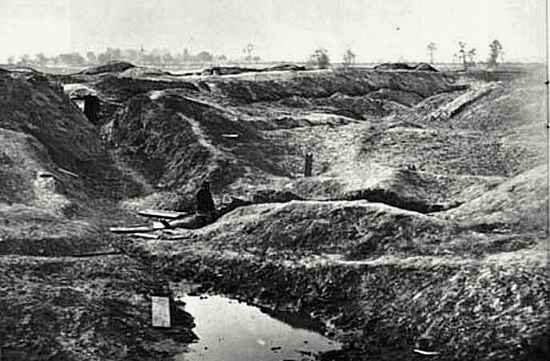
The Crater in 1865 (Courtesy of RVA News)
|
In his memoirs, General Grant lays the blame squarely on Burnside for failing to untangle his divisions and press the attack.[10] Grant does, however, deserve some blame for his last minute decision to change Burnside’s order of battle. Nevertheless, a Court of Inquiry was held shortly afterwards, resulting in Burnside being relieved of command.[11] With Union forces having failed to break the Confederate defenses, the deadly trench warfare around the town of Petersburg would continue until April 2, 1865.
|
Citations
Cover Image: Battle of the Crater (Courtesy of Wikipedia)
[1] Levin, 18-19; quoted in Levin, 19.
[2] Levin, 21, 31.
[3] Levin, 25-26.
[4] Letter from Laban Odom to his wife, quoted in Levin, 27.
[5] Bernard, 159; Bernard says the sergeant was killed instantly by the second shot, but its placement in the man’s stomach would refute this claim. The sergeant would have suffered for at least a few more minutes as he bled to death from the wound. Being veteran soldiers by this point in the war, it is likely the shooter was well aware of this and intentionally placed his shot the way he did to prolong the man’s suffering.
[6] Bernard, 160.
[7] Levin, 19; Greene, 515.
[8] Bryce A. Suderow, “The Battle of the Crater: The Civil War’s Worst Massacre,” Civil War History 43, no. 3, 1997, 219-224. [link]
[9] Levin, 7; While I couldn’t find a place to put it in the essay, historian Wilson Greene relays an account from Union LT. Baird who recalls that his Colonel executed a Confederate prisoner for refusing to carry the stretcher of a wounded USCT. This presents the question of counter-reprisals by Union troops who witnessed the Confederate’s brutality. Perhaps a topic for future research (Greene, 489).
[10] Grant, 295.
[11] “Record of the Court of Inquiry on the Mine Explosion,” OR, ser. 1, vol. 40, part 1, 42-129.
[1] Levin, 18-19; quoted in Levin, 19.
[2] Levin, 21, 31.
[3] Levin, 25-26.
[4] Letter from Laban Odom to his wife, quoted in Levin, 27.
[5] Bernard, 159; Bernard says the sergeant was killed instantly by the second shot, but its placement in the man’s stomach would refute this claim. The sergeant would have suffered for at least a few more minutes as he bled to death from the wound. Being veteran soldiers by this point in the war, it is likely the shooter was well aware of this and intentionally placed his shot the way he did to prolong the man’s suffering.
[6] Bernard, 160.
[7] Levin, 19; Greene, 515.
[8] Bryce A. Suderow, “The Battle of the Crater: The Civil War’s Worst Massacre,” Civil War History 43, no. 3, 1997, 219-224. [link]
[9] Levin, 7; While I couldn’t find a place to put it in the essay, historian Wilson Greene relays an account from Union LT. Baird who recalls that his Colonel executed a Confederate prisoner for refusing to carry the stretcher of a wounded USCT. This presents the question of counter-reprisals by Union troops who witnessed the Confederate’s brutality. Perhaps a topic for future research (Greene, 489).
[10] Grant, 295.
[11] “Record of the Court of Inquiry on the Mine Explosion,” OR, ser. 1, vol. 40, part 1, 42-129.
